EU AI Act and Hiring: What Employers Need to Do Before December 2027

Scott Poniewaz
November 12, 2026 · 11 min read
Updated November 2026
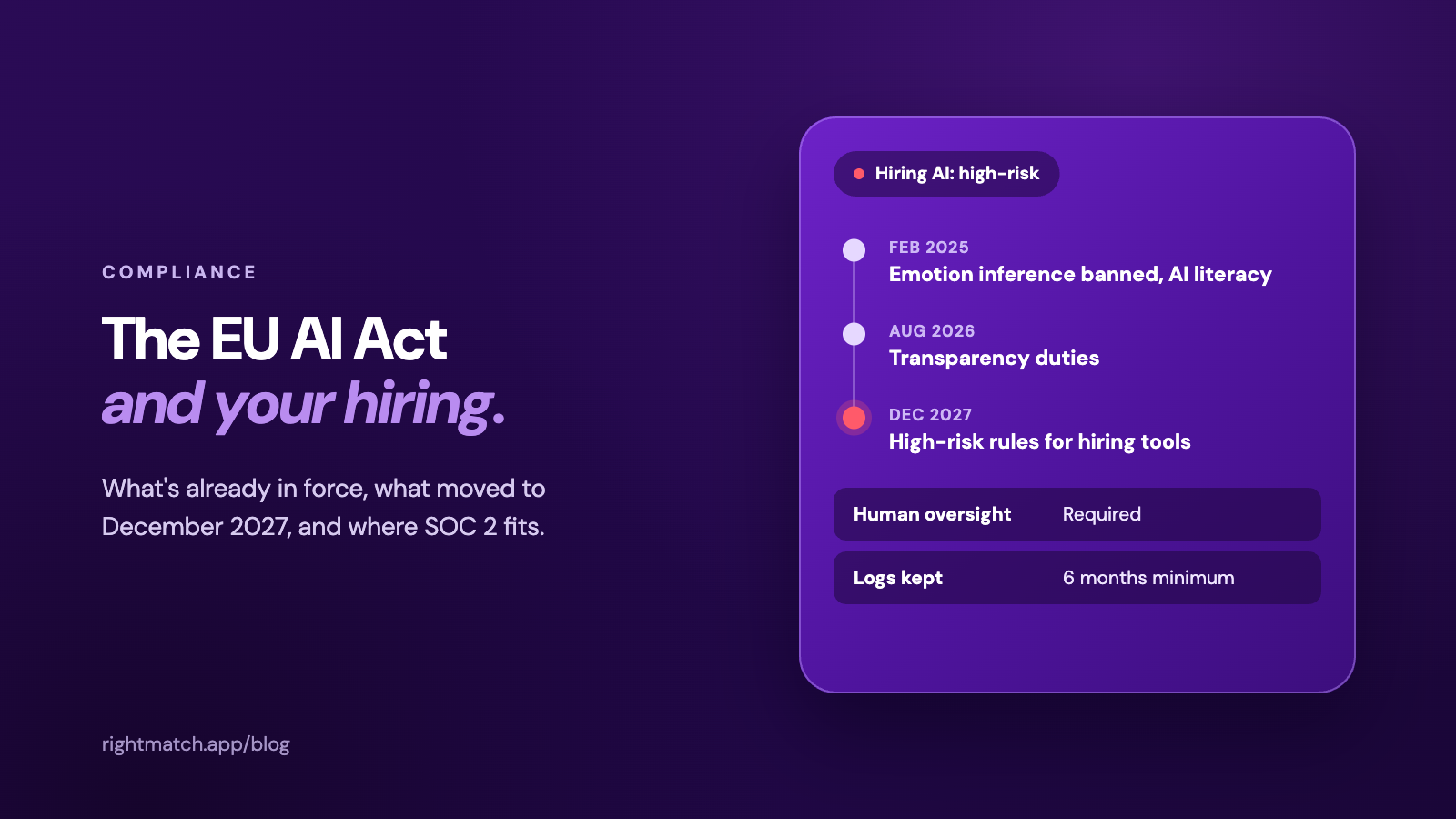
AI used to recruit, screen or evaluate job candidates is classed as high-risk under the EU AI Act. The strict rules for those systems were due in August 2026, but the EU’s Digital Omnibus pushed them back to 2 December 2027. Don’t relax yet. A few rules already apply to hiring today, including a ban on inferring emotions at work and a duty to support AI literacy among the people who use these tools. And the Act can reach companies outside the EU, including US employers, when AI is used in the EU or its output is used there.
This guide is general information, not legal advice. Talk to counsel about your specific setup.
Book a 20-minute demo | Start free
The timeline at a glance
| Date | What applies | What it means for hiring |
|---|---|---|
| 2 February 2025 | Banned practices (Article 5) and AI literacy (Article 4) | No inferring emotions of candidates or employees. You must take steps to build AI literacy among the staff and contractors who use these tools |
| 2 August 2025 | General-purpose AI model rules | Aimed at the companies that build the models, not employers using a vendor’s tool |
| 2 August 2026 | Transparency duties (Article 50) | Tell people when they’re exposed to emotion recognition or biometric categorisation, and label deepfakes you publish. National authorities have also been enforcing AI literacy since this date |
| 2 December 2027 | High-risk rules for Annex III uses, including recruitment and employment (moved from 2 August 2026) | The big one for hiring tools: risk management, documentation, human oversight, logging, notices |
| 2 August 2028 | High-risk AI built into regulated products (Annex I) | Mostly not hiring tools |
Why August 2026 isn’t the date anymore
Many articles still say high-risk hiring rules started in August 2026. They didn’t. The Digital Omnibus on AI was adopted as Regulation 2026/1744 before that deadline, and it delayed the Annex III rules by 16 months. The main reason was that the harmonised technical standards weren’t ready. The delay moves the date. It doesn’t change the classification: AI used in recruitment and employment is still high-risk.
Does it apply to you?
If you hire in the EU, yes. If you’re a staffing firm or RPO recruiting for EU clients, yes. If you’re based in the US or anywhere else, it can still apply, for example when you screen candidates located in the EU or your AI output is used there. The Act separates two roles:
- Providers build and sell the AI system. That’s your software vendors.
- Deployers use it. That’s you, the employer or the recruiting team.
Both have duties, and a contract clause doesn’t move yours onto the vendor.
What counts as high-risk in hiring
The Act lists these uses in Annex III, point 4, under employment and worker management:
- Recruiting and selecting people. Placing targeted job ads, analysing and filtering applications, and evaluating candidates.
- Decisions during employment. Promotion, termination, assigning tasks based on behaviour or personal traits, and monitoring or evaluating performance.
In practice that covers resume screening and ranking, interview scoring and analysis, and candidate matching. There’s a narrow exemption in Article 6(3) for things like a purely procedural task or a preparatory step, but any system that profiles people stays high-risk. Tools that score or rank candidates generally don’t qualify for the exemption. Whether yours does is a question for your lawyer.
What’s already banned
Since February 2025, the Act bans AI systems that infer emotions in the workplace or in education, with exceptions only for medical or safety reasons. For hiring, that means analysis of candidates’ or employees’ emotions is off the table. If a tool claims to read confidence, enthusiasm or personality from someone’s face or voice, that’s the first thing to ask about. The top fine tier, up to 35 million euros or 7% of worldwide turnover, applies to banned practices.
Who owes what
| Vendors (providers) | Employers (deployers) |
|---|---|
| Risk management system | Use the system according to its instructions |
| Data governance and quality | Assign trained people with real authority to oversee it and override it |
| Technical documentation and instructions for use | Make sure the data you feed it is relevant |
| Logging and traceability | Monitor it and report serious incidents |
| Human oversight built into the design | Keep the logs the system generates for at least six months |
| Accuracy, robustness and cybersecurity | Tell workers and their representatives before you put a high-risk system into use at work (Article 26(7)) |
| Quality management and conformity assessment | Tell candidates when a high-risk system is used to make or assist decisions about them |
| Registration in the EU database | Explain an individual decision when someone asks (Article 86), and keep up your GDPR duties |
“A person clicks approve at the end” doesn’t satisfy human oversight on its own. The reviewer has to understand the output, be able to question it, and have the authority to overrule it. A rubber stamp doesn’t count.
Where SOC 2 fits, and where it doesn’t
SOC 2 is not an EU AI Act certification, and nobody can honestly sell it as one. It’s an independent audit of how a company protects customer data. A SOC 2 Type II report goes a step further than Type I: it tests whether those controls actually worked over a period of time, not just on one day.
That still makes it useful evidence for a real slice of what the Act asks, especially for the vendor due diligence you’re expected to do.
| The AI Act asks for | What SOC 2 helps you see | What it doesn’t cover |
|---|---|---|
| Cybersecurity and robustness (Article 15) | Access controls, encryption, monitoring and incident response, tested over time | AI-specific attacks and how accurate the model is |
| Logging and traceability | Audit logging, change management and retention practices | Whether the logs capture what the Act requires for each decision |
| Vendor due diligence | An independent auditor’s report you can request and read | Whether the product meets the high-risk requirements |
| Data governance | Confidentiality and privacy controls | Bias testing and the quality of training data |
| Human oversight, transparency, bias testing, conformity assessment | Not covered | These need product design, documentation and a separate assessment |
If a vendor sends you a SOC 2 report, read it. Check the scope, the audit period, and any exceptions the auditor noted.
Your readiness checklist
You have about a year, and the standards are still taking shape. Here’s what we’d do now.
- List every AI tool in your hiring process. ATS features, screening, interview tools, chatbots, sourcing tools, and general assistants like ChatGPT or Claude that your recruiters use.
- Classify each one. Banned, high-risk, transparency only, or low risk.
- Check for emotion inference. If anything claims to read emotions or personality, ask the vendor in writing.
- Send your vendors the questions below. Keep the answers on file.
- Name a human oversight owner for each high-risk tool. Someone trained, with authority to override it.
- Decide where a person reviews before a decision sticks. Write it down.
- Plan your notices. Candidates and employees need to know when these systems are in use.
- Start an AI literacy record. The Omnibus softened this duty to taking measures to support literacy, but it still applies. The Commission’s FAQ says no certificate is required and an internal record of training is acceptable.
- Line up GDPR. Data protection impact assessments, and the rules on solely automated decisions.
- Set a review date. Revisit the list twice a year as the standards firm up.
Nine questions to ask any hiring AI vendor
- Which AI Act risk category do you put this product in, and why?
- Does any feature infer emotions, personality or traits from faces, voices or behaviour?
- What documentation do you give deployers: intended purpose, instructions for use, known limits?
- How does a person review and override the output? Can the tool act without approval?
- What do you log, how long can I keep it, and can I export it?
- How have you tested for bias, and can I see the results?
- Do you have a SOC 2 Type II report, and can I read it?
- Where does candidate data go, who are your subprocessors, and do you have a data processing agreement with Standard Contractual Clauses for EU data?
- What’s your plan for conformity assessment and EU database registration before December 2027?
How RightMatch approaches it
We’re going to be straight about this: we won’t tell you RightMatch is “EU AI Act compliant.” The high-risk process isn’t live yet, the standards aren’t finished, and anyone claiming a certificate today is ahead of the rules. Here’s what we can show you now.
- A person makes the call. RightMatch scores and ranks candidates. Your team decides. Auto-advancement exists, but it’s off by default.
- Scores you can check. Scorecards cite evidence from the interview transcript, so you can see why a candidate scored the way they did.
- Same questions for every candidate. Async video interviews are structured, so everyone answers the same set.
- Fraud signals based on how an interview was taken. Trust Score looks at things like copy and paste, browser switching, timing anomalies, second monitors and answers that read like AI. It flags, and a person decides.
- Independent security audit. RightMatch is SOC 2 Type II certified.
- Data protection paperwork. Our data processing agreement covers GDPR and UK GDPR, including Standard Contractual Clauses.
If you also use ChatGPT or Claude in your hiring process, see our guide to using ChatGPT and Claude for recruiting, including how to connect them to RightMatch with a person still in the loop.
FAQ
Is AI recruiting software high-risk under the EU AI Act?
Generally, yes. Annex III lists AI used to recruit, select, filter and evaluate candidates as high-risk, and tools that rank or score people generally can’t use the narrow exemption.
Did the high-risk deadline move?
Yes. The Digital Omnibus moved the Annex III high-risk obligations from 2 August 2026 to 2 December 2027. Older articles that say August 2026 are out of date.
Do I need to stop using AI in hiring now?
No. High-risk AI isn’t banned. But the emotion-inference ban and the AI literacy duty already apply, and the rest is coming. Use the time to inventory your tools and talk to your vendors.
Does the Act apply to US companies?
It can. If you use AI systems in the EU, or the output is used in the EU, for example when screening candidates in EU countries, the Act can apply no matter where you’re headquartered.
If a human makes the final decision, am I exempt?
Not by itself. The system can still be high-risk, and the oversight has to be real. The reviewer needs to understand the output and have the authority to overrule it.
What are the penalties?
Up to 35 million euros or 7% of worldwide annual turnover for banned practices, up to 15 million euros or 3% for most other obligations including deployer duties, and up to 7.5 million euros or 1% for giving authorities incorrect information. The higher figure applies, except for small businesses, where the lower one does.
Is SOC 2 enough?
No. SOC 2 shows how a vendor protects data, and it’s good evidence for the security side. It doesn’t cover human oversight, bias testing, transparency or conformity assessment.
Does using ChatGPT or Claude to screen resumes count?
It can. Using a general chatbot to rank candidates is a hiring use of AI, which puts deployer duties on you. Depending on how you set it up, you could even be treated as the provider, which carries heavier duties. That’s one reason to use a purpose-built tool, and to get legal advice.
What about NYC Local Law 144 and other rules?
They’re separate. New York City’s law requires bias audits and candidate notice for automated employment decision tools, and GDPR limits decisions made solely by automated means. Meeting one doesn’t cover the others.
Want to see how it works?
We’ll walk through scoring, scorecards, human review and Trust Score with your own roles. Book a 20-minute demo or start free.
Sources
- Cooley, Digital AI Omnibus delays key deadlines
- Gibson Dunn, EU AI Act omnibus agreement
- AIACTO, Digital Omnibus adopted
- ActuIA, AI Act obligations in force and delays under Omnibus 2026/1744
- ActuIA, HR tools and AI: Europe delays high-risk obligations to December 2027
- artificialintelligenceact.eu, What the EU AI Act means for staffing businesses
- Learnsignal, AI in recruitment and HR under the EU AI Act
- 4Spot Consulting, EU AI Act: navigating high-risk compliance in automated hiring
- Freshfields, EU AI Act unpacked: understanding fines
- euaiact.com, EU AI Act penalties and enforcement